Your most expensive decisions are made with the least information

And limited visibility doesn't just create risk - it can hide a better design entirely

Your most expensive decisions are made with the least information

And limited visibility doesn't just create risk - it can hide a better design entirely

Your most expensive decisions are made with the least information

And limited visibility doesn't just create risk -
it can hide a better design entirely

Your most expensive decisions are made with the least information

And limited visibility doesn't just create risk — it can hide a better design entirely.

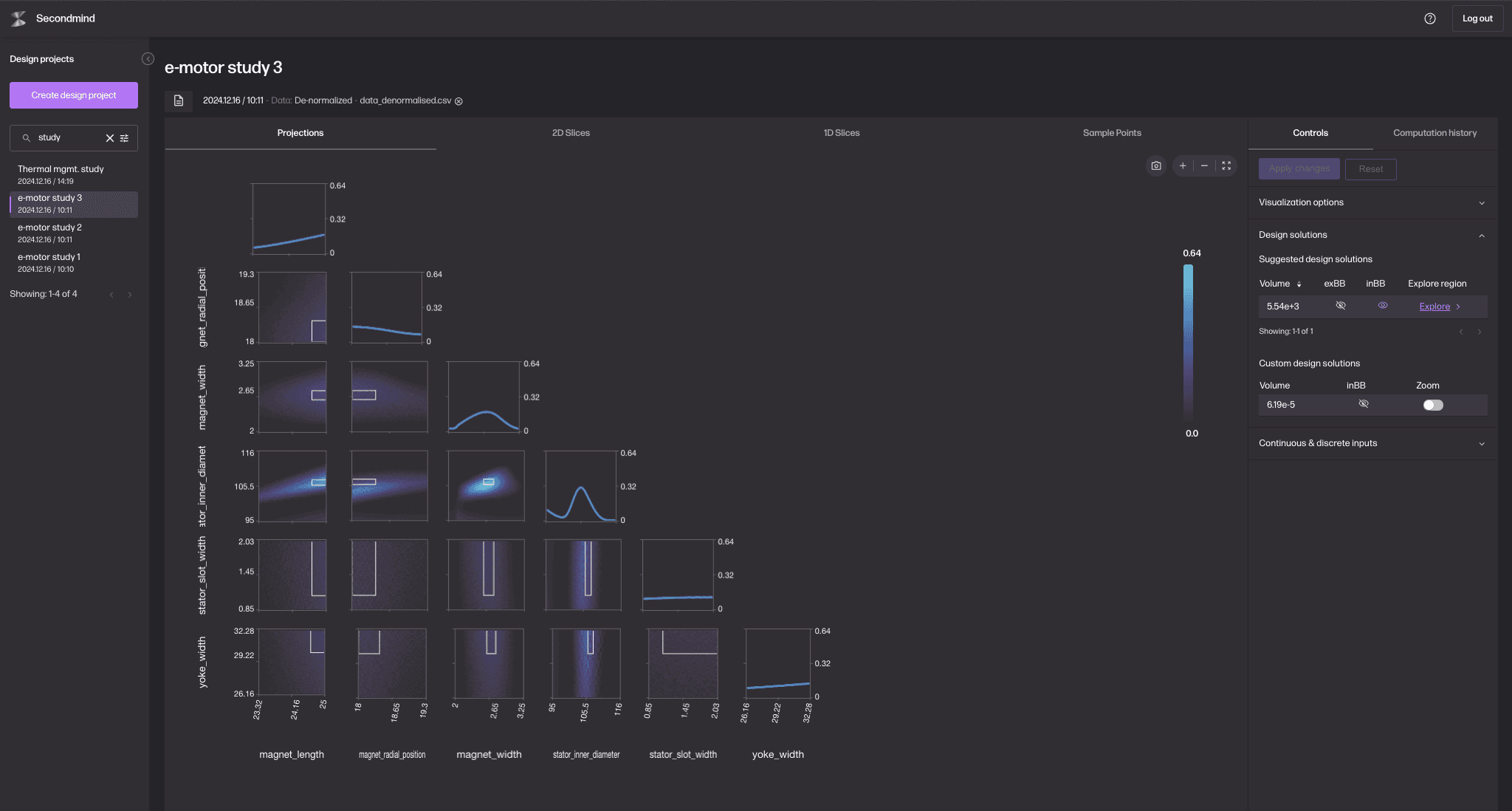
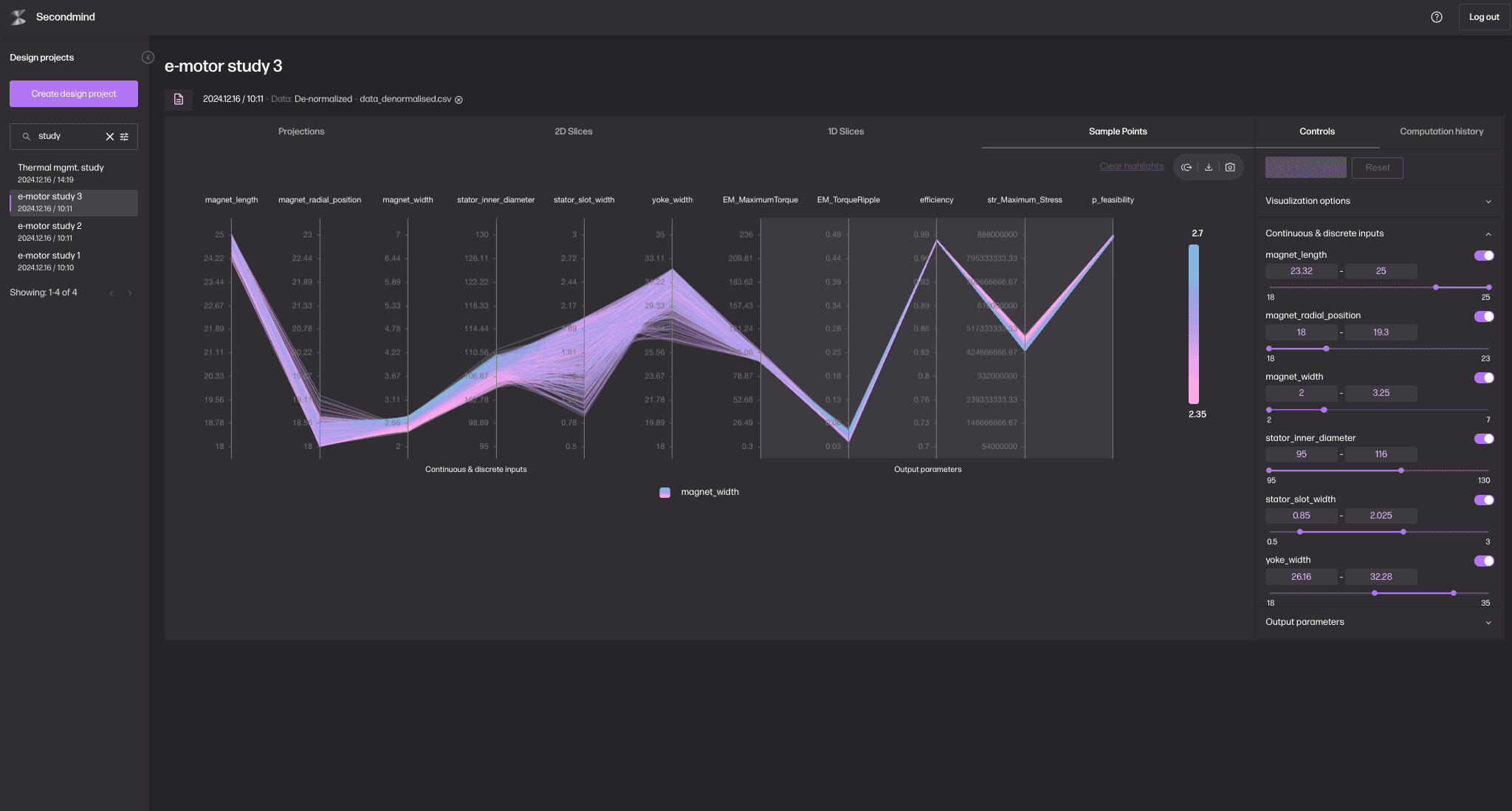
Secondmind for Design Space Exploration maps the entire feasible design space with minimal simulations. Engineers can focus exploration only on designs confirmed to meet requirements — surfacing novel design candidates that conventional approaches could never reach, since they are limited to a single starting point.

The challenge

Complex systems create complex trade-offs — and conventional tools aren’t built for them, slowing teams down and putting program delivery at risk.

Months spent, only a fraction of the space explored

Time pressures mean it is only possible to explore a small part of the design space — committing resources means gambling on a direction with no way to confirm it's the right one.

Costs lock in before the evidence exists

Early decisions commit most of a program's cost, before conventional tools have enough data to produce reliable evidence — so by the time a gap surfaces, it's far more expensive to fix.

No proof it's the best design — and no room to adapt

Without visibility across the full space, there's no way to confirm a better trade-off doesn't exist elsewhere — and any requirement change resets the timeline.

The Secondmind solution

Secondmind for Design Space Exploration gives engineers the information to make better decisions earlier, resulting in significantly less rework.

Explore more, in far less time

Map the entire feasible space with up to 90% fewer simulations a fixed plan would need - surfacing high-performing designs previously out of reach.

Commit with confidence

Carry multiple feasible designs forward, and commit only once confidence is high enough to get it right, first time - avoiding costly late-stage rework.

Visible trade-offs, room to adapt

See exactly where the best trade-offs lie, and when a requirement changes, its impact is visible immediately - without restarting from scratch.

Explore more, in far less time

Map the entire feasible space with up to 90% fewer simulations a fixed plan would need — surfacing high-performing designs previously out of reach.

Commit with confidence

Carry multiple feasible designs forward, and commit only once confidence is high enough to get it right, first time — avoiding costly late-stage rework.

Visible trade-offs, room to adapt

See exactly where the best trade-offs lie, and when a requirement changes, its impact is visible immediately — without restarting from scratch.

The Secondmind solution

Secondmind for Design Space Exploration gives engineers the information to make better decisions earlier, resulting in significantly less rework.

Explore more, in far less time

Map the entire feasible space with up to 90% fewer simulations a fixed plan would need - surfacing high-performing designs previously out of reach.

Commit with confidence

Carry multiple feasible designs forward, and commit only once confidence is high enough to get it right, first time - avoiding costly late-stage rework.

Visible trade-offs, room to adapt

See exactly where the best trade-offs lie, and when a requirement changes, its impact is visible immediately - without restarting from scratch.

Explore more, in far less time

Map the entire feasible space with up to 90% fewer simulations a fixed plan would need — surfacing high-performing designs previously out of reach.

Commit with confidence

Carry multiple feasible designs forward, and commit only once confidence is high enough to get it right, first time — avoiding costly late-stage rework.

Visible trade-offs, room to adapt

See exactly where the best trade-offs lie, and when a requirement changes, its impact is visible immediately — without restarting from scratch.

Explore

Explore

Key features

Key features

Secondmind gives engineers different features to map the design space, compare candidates, and commit with confidence.

Secondmind gives engineers different features to map the design space, compare candidates,
and commit with confidence.

Requirements Visualizer

Adapt to changing requirements, instantly — no new simulations required.

Adjust a requirement threshold and see the impact on feasibility.

Identify which requirements are actually limiting the design — and relax them to open up new feasible designs.

Challenge or defend a requirement with data, not opinion.

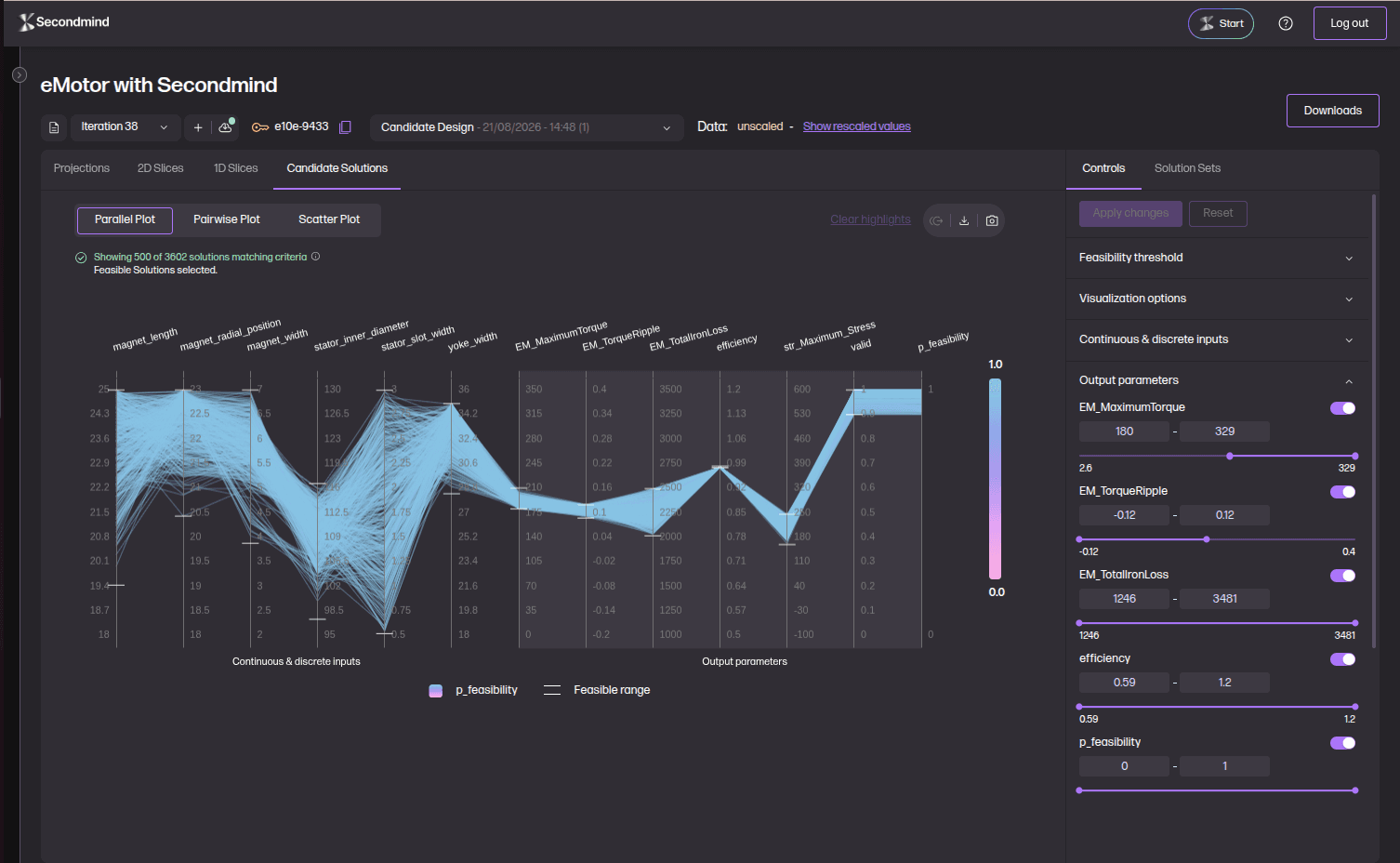
Candidate Solutions

Explore and discover the best designs — and commit with confidence.

Compare candidate designs drawn from across the full feasible space.

Focus on a specific region, or explore broadly across the whole space.

Refine criteria in real time as new questions arise.

Candidate Solutions

Explore and discover the best designs - and commit with confidence.

Compare candidate designs drawn from across the full feasible space.

Focus on a specific region, or explore broadly across the whole space.

Refine criteria in real time as new questions arise.

Multi-objective Optimization

Reveal the best trade-off across multiple requirements.

Identify where the best trade-offs lie.

See how far one requirement can be pushed before conceding ground on another.

Compare trade-offs within existing constraints and requirements — not a separate, unconstrained search.

Feasibility Boundary

Know the absolute limits of what's possible.

Map the full boundary of every design that meets system-level requirements.

Confirm every viable option has been considered, with nothing feasible left undiscovered.

Present stakeholders with a clear view of what is, and isn't, possible before committing to a direction.
Safe Operating Envelope

Develop in parallel, without integration risk.

Explore a set of designs already confirmed to meet system requirements.

Work in parallel across different teams from a shared feasible design space.

Avoid downstream integration conflicts since every team is developing within a shared, compatible feasible design space.

Proven results

Delivers faster time-to-market, lower development costs, and better-performing results.

Faster
time-to-market

6x faster

Hundreds of feasible designs found in just two weeks, where incumbent tools yielded zero results after three months.

Lower
development costs

90%

reduction in CAE simulation runs compared to standalone CAE tools.

Better quality and performance

$27

per-unit BOM cost reduction

— an estimated $11M in annual savings at mass-production volumes for one OEM.

The Secondmind advantage

The technology powering the result — working together, not in isolation.

Every single simulation earns its place

Secondmind Active Learning targets the gaps in the model rather than collecting data indiscriminately — reaching a reliable result in a fraction of the simulations a fixed plan would need.

Precision where it matters — the boundary itself

Model precision concentrates around the feasibility boundary, not spread evenly across the whole space. Every result carries a confidence level, so engineers know when that boundary can be trusted.

The entire feasible space, made accessible

Rather than a single design point, engineers get a full set of viable options, faster than conventional sampling. Interactive plots reveal which parameters drive performance and where trade-offs emerge.

Enterprise-ready

ISO 27001 certified. Cloud-native, browser-based, no new infrastructure.
Integrates with existing CAE workflows, including GT-Suite, MATLAB/Simulink, and JSOL JMAG.

Example use cases

Complex products, dozens of interacting variables, measurable impact.

E-motor design

Reduced bill-of-materials cost by $27/unit while improving torque, reliability, and NVH simultaneously.

Piston bowl design

Explored 3x more feasible designs than existing CAE tools, in 50% less time - balancing fuel, emissions, and heat transfer targets.

3-cylinder engine design

Found a robust engine mount design in 400 simulations vs. 78,000+ conventionally required - uncovering a hidden interaction standard methods missed.

Example use cases

Complex products, dozens of interacting variables, measurable impact.

E-motor design

Reduced bill-of-materials cost by $27/unit while improving torque, reliability, and NVH simultaneously.

Piston bowl design

Explored 3x more feasible designs than existing CAE tools, in 50% less time - balancing fuel, emissions, and heat transfer targets.

3-cylinder engine design

Found a robust engine mount design in 400 simulations vs. 78,000+ conventionally required - uncovering a hidden interaction standard methods missed.

Ready to see what's feasible?

Book a demo to see how Secondmind for Design Space Exploration could accelerate your program.

Ready to see what's feasible?

Book a demo to see how Secondmind for Design Space Exploration could accelerate your program.

Example use cases

Complex products, dozens of interacting variables, measurable impact.

E-motor design

Reduced bill-of-materials cost for a major OEM by $27/unit while improving torque, reliability, and NVH simultaneously.

Piston bowl design

Explored 3x more feasible designs than existing CAE tools, in 50% less time — balancing fuel, emissions, and heat transfer targets.

3-cylinder engine design

Found a robust engine mount design in 400 simulations vs. 78,000+ conventionally required — uncovering a hidden interaction standard methods missed.

Example use cases

Complex products, dozens of interacting variables, measurable impact.

E-motor design

Reduced bill-of-materials cost for a major OEM by $27/unit while improving torque, reliability, and NVH simultaneously.

Piston bowl design

Explored 3x more feasible designs than existing CAE tools, in 50% less time — balancing fuel, emissions, and heat transfer targets.

3-cylinder engine design

Found a robust engine mount design in 400 simulations vs. 78,000+ conventionally required — uncovering a hidden interaction standard methods missed.

Example use cases

Complex products, dozens of interacting variables, measurable impact.

E-motor design

Reduced bill-of-materials cost for a major OEM by $27/unit while improving torque, reliability, and NVH simultaneously.

Piston bowl design

Explored 3x more feasible designs than existing CAE tools, in 50% less time — balancing fuel, emissions, and heat transfer targets.

3-cylinder engine design

Found a robust engine mount design in 400 simulations vs. 78,000+ conventionally required — uncovering a hidden interaction standard methods missed.

Ready to see what's feasible?

Book a demo to see how Secondmind for Design Space Exploration could accelerate your program.

Ready to see what's feasible?

Book a demo to see how Secondmind for Design Space Exploration could accelerate your program.

Ready to see what's feasible?

Book a demo to see how Secondmind for Design Space Exploration could accelerate your program.

Ready to see what's feasible?

Book a demo to see how Secondmind for Design Space Exploration could accelerate your program.

Ready to see what's feasible?

Book a demo to see how Secondmind for Design Space Exploration could accelerate your program.

Insights

Stay ahead in a rapidly evolving industry. Access our latest resources, insights, and tools to equip you with the knowledge you need to stay competitive.

Insights

Stay ahead in a rapidly evolving industry. Access our latest resources, insights, and tools to equip you with the knowledge you need to stay competitive.

Insights

Stay ahead in a rapidly evolving industry. Access our latest resources, insights, and tools to equip you with the knowledge you need to stay competitive.

Insights

Stay ahead in a rapidly evolving industry. Access our latest resources, insights, and tools to equip you with the knowledge you need to stay competitive.