Unlocking the full value of parallel compute through batch sampling
Engineering teams have more parallel compute than ever, and most of it is being wasted - new Secondmind research addresses this directly. In this new blog, Secondmind Research Intern and paper co-author Max Bloor explains how

Ask a conventional optimizer for 100 candidate designs to test concurrently and it will often hand back near-duplicates, all clustered around the same promising solution. You paid for 100 simulations, but in reality only a fraction told you anything new. Engineering teams have more parallel compute than ever, and most of it is being wasted.
New Secondmind research introduces a framework that addresses this directly. B3O (Boltzmann Batch Bayesian Optimization) reformulates how a batch of candidate designs gets generated in the first place. The result is an algorithm that maintains diversity across a hundred parallel simulations, scales linearly with batch size, and adapts across engineering problems. To see what that looks like in practice, consider the problem we used to demonstrate it: battery cell design.
The battery design trade-off
To build a better EV, you need a battery cell with high specific energy (for range) and high specific power (for acceleration and charging). These two properties usually compete against each other.
Thicken the electrodes for more energy and ion transport resistance increases, descreasing power. Reduce thickness for more power and you lose capacity, hurting energy. Every microstructural decision (porosity, particle radius, active material volume fraction) sits in tension across both objectives. Engineers have to tune nine of these parameters simultaneously to find designs that balance the two.
We demonstrated B3O on a multi-objective electrode design task using a high-fidelity battery physics simulator widely used in industrial cell development. The optimization tunes nine real microstructural parameters across both anode and cathode, against the simultaneous maximization of specific energy and specific power. It mirrors the engineering workflow real cell designers run.
Sampling, not searching
In conventional Bayesian optimization, designs are suggested one by one. Before a design is suggested, the algorithm builds a function of where the next best point to evaluate is. The difficulty comes when you ask for more than one design. That function has a peak, and the best next point sits on it, as does the second best, and the third. Ask for 50 and they crowd onto the same peak. The usual approach in batch Bayesian Optimization is to make each candidate aware of the others and optimize all 50 jointly, but that is a far larger search than optimizing one, and the cost climbs steeply as the batch grows.
B3O takes a different approach. Rather than optimizing a batch objective over 50 candidates at once, we build a probability distribution directly from the utility function and draw the batch from it.
If you have ever studied how gas molecules spread across energy states at a given temperature, the construction will feel familiar. This is the Boltzmann distribution, a classical tool from statistical physics. Most molecules sit in the low-energy states, but a predictable fraction reaches into higher ones, and how widely they spread depends entirely on temperature. B3O borrows the same idea, treating high-utility regions of the design space the way physics treats low-energy states.
Every decision maker has to balance two competing pulls: exploiting the regions that already look good, and exploring the regions it has not yet tried. The Boltzmann distribution holds both at once. It assigns higher probability to high-utility regions while still placing nonzero mass on the rest of the design space. Draw 50 independent samples and you get a batch that is diverse, focused on promising regions whilst not forgetting to explore, and ready to run all at once. Because each sample is drawn independently, there is no ordering or dependency between the designs and nothing to coordinate. All 50 can be dispatched to the cluster in a single shot.
Temperature is the single tuning parameter of the method, and it directly controls the diversity of the batch. The physics intuition transfers cleanly. At high temperatures, the batch has the energy to spread out across the design space, favouring exploration. At low temperatures, it settles toward the acquisition peaks, favouring exploitation.
The 12-iteration battery
Back to the electrode design. We approximated the true optimum as a reference, then compared B3O against a standard sequential Bayesian optimization technique given a 600-evaluation budget.
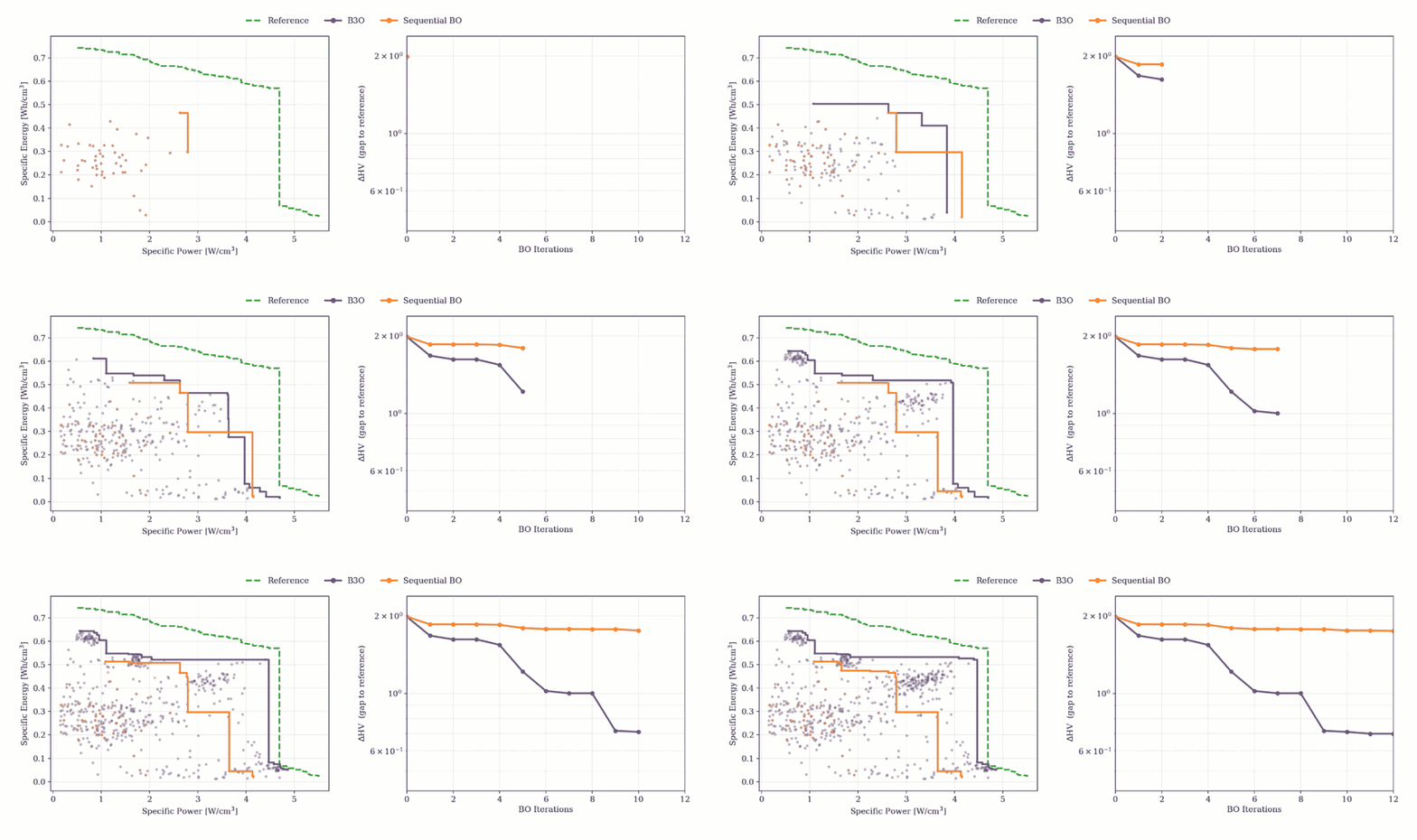
What changed was how those evaluations were used. B3O ran them in 12 iterations of 50 parallel designs rather than 600 sequential steps. In any multi-objective problem, the Pareto front is the set of designs where gaining more of one goal inevitably means compromising another. The Pareto front B3O identified is diverse, well-distributed, and closely matched the reference optimum at a fraction of the cost.
Beyond batteries: race car configuration
The battery problem is fully continuous. To show the versatility of B3O, we applied the identical pipeline to a different engineering problem: Formula E race car configuration.
This task uses a lap-time simulator and minimizes a combined lap-time and energy-use metric on the Shanghai circuit. The design space is mixed. Four continuous variables (motor torque, drag area, rear downforce, weight distribution) alongside two discrete categorical choices (gear ratio and maximum power setting).
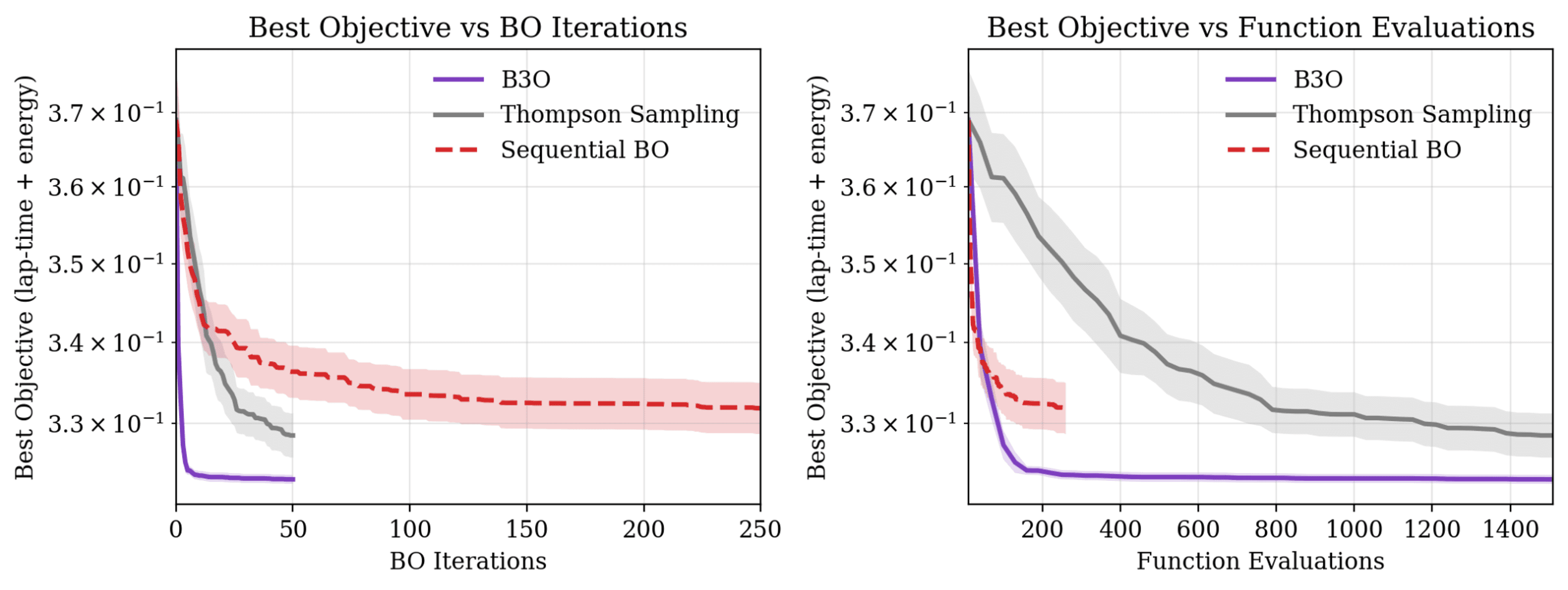
For B3O, the fix was a single component change. We replaced the continuous sampler with a sampling scheme for mixed spaces. The surrogate, the acquisition function, the BO loop, all untouched. B3O converged on the best configurations in under 20 iterations, while existing batch approaches needed several hundred to reach a comparable lap time. A sequential mixed-variable baseline did not catch up within its evaluation budget.
Toward high-throughput engineering
The B3O research reflects the shift in how Secondmind thinks about Engineering AI. For years, optimization research focused on accuracy per evaluation. The new bottleneck is different. It is getting value out of the parallel compute teams already have.
A batch method that proposes 100 designs but explores only five distinct regions is wasting 95 simulation slots. The same team running B3O gets 100 simulations of genuinely different designs, feeding 100 simulations' worth of new information into the next surrogate update. Across the hundreds of iterations of a typical design campaign, that is the difference between days and weeks of simulation cycles - moving the entire program forward and reaching physical validation far sooner.
By distilling state-of-the-art research into a single flexible algorithm, B3O continues Secondmind's work of bridging academic research and enterprise-grade Engineering AI. Whether the problem is a battery electrode, a race car configuration, a chassis material, or a powertrain calibration map, B3O unlocks the parallel compute teams have already paid to condense design campaigns.
Read the paper: https://arxiv.org/abs/2606.30228

Learn more
Want to see how Secondmind can help you with your most complex engineering challenges?