The power of unification: simplifying combinatorial design in automotive engineering
Victor Picheny, Director of Research at Secondmind, introduces NeurIPS 2025 research that simplifies combinatorial design in automotive engineering through a unified "heat kernel" framework.

In the pursuit of the next generation of high-performance vehicles, automotive engineers face a daunting reality: the most critical design decisions aren't always about fine-tuning a continuous variable - like the thickness of a structural component or the precise length of a suspension arm. Often, they are fundamentally categorical.
Whether you are selecting a specific lightweight alloy for a chassis, choosing between a front-wheel, rear-wheel, or all-wheel drive architecture, or deciding on a suspension type like multi-link or double wishbone, you are navigating a discrete search space. When you combine these choices, you trigger a "combinatorial explosion". This is a phenomenon best illustrated by the classical story of the chessboard and the grains of rice.
The chessboard and the rice
Legend has it that when the inventor of chess showed his game to the king, he asked for a simple reward: one grain of rice for the first square, two for the second, four for the third, and so on, doubling the amount for each of the 64 squares. The king, thinking it a modest request, soon realized the mathematical trap. By the time you reach the end of the board, the number of grains exceeds the world's total rice production many times over.
In automotive design, every choice, such as a different battery cell, a new gear ratio, or a specific software logic, is like moving to the next square on that chessboard. What starts as a few simple options quickly explodes into a quintillion-grain problem. This creates a vast expanse of design possibilities that no human, nor traditional simulation, can explore blindly.
The small data challenge
Unlike the world of Large Language Models (LLMs), which feast on trillions of data points, automotive engineering exists in a "small data regime." Every physical prototype or high-fidelity simulation is expensive and time-consuming. We need to make high-stakes decisions with just a handful of observations.
While Bayesian optimization (BO) is the gold standard for this challenge, its application to categorical "combinatorial" spaces has historically been a confusing array of specialized methodologies, making it difficult for industrial practitioners to identify a clear path across the board.
Simplifying the strategy
Until now, the academic landscape for combinatorial BO has looked like a jungle of competing kernels and algorithms: CASMOPOLITAN, COMBO, BOSS, and Bounce, to name a few. For practitioners, this has made it difficult to find a "sweet spot" - navigating a landscape where some methods are fast but inaccurate, while others are theoretically powerful but prohibitively complex to deploy in a production environment.
New research presented at NeurIPS 2025, a collaboration between ETH Zürich, the University of Cambridge, and Secondmind, provides the unified strategy this field has been missing. The discovery was a breakthrough in simplicity: most of these seemingly disparate methods are actually mathematically equivalent or closely related.
By developing a unified framework based on "heat kernels," the team simplified these various theories into a single, robust framework. They proved that complex graph-based approaches and simple one-hot encoding methods are often two sides of the same coin.
From theory to the test track
This unification provides immediate practical advantages for industrial design. By adopting a "simple and fast" heat-kernel pipeline, we achieve a new standard for performance and flexibility:
State-of-the-art speed and simplicity: Our implementation is twice as fast as methods like COMBO. While specialized tools like CoCaBo remain the fastest, heat kernels hit the "sweet spot": almost as fast as the quickest, yet as accurate as the very best.
Robustness without bias: Many existing algorithms carry implicit assumptions: for instance, expecting the optimal design to sit at the "edges" of the search space or assuming it must contain identical categories. These biases can lead to failure when the true optimum doesn't fit the expected pattern. Heat kernels, by contrast, are remarkably stable; they provide a neutral, flexible framework that matches the reliability of the best specialized methods regardless of how the optimal design is structured.
Easy customization: The heat kernel formalism makes it simple to incorporate physical structures or invariances - such as battery chemistry constraints or chassis symmetry - without reinventing the underlying math.
Benchmark performance: Across Neural Architecture Search and materials science tasks, this simplified pipeline consistently matched or outperformed far more complex algorithms.
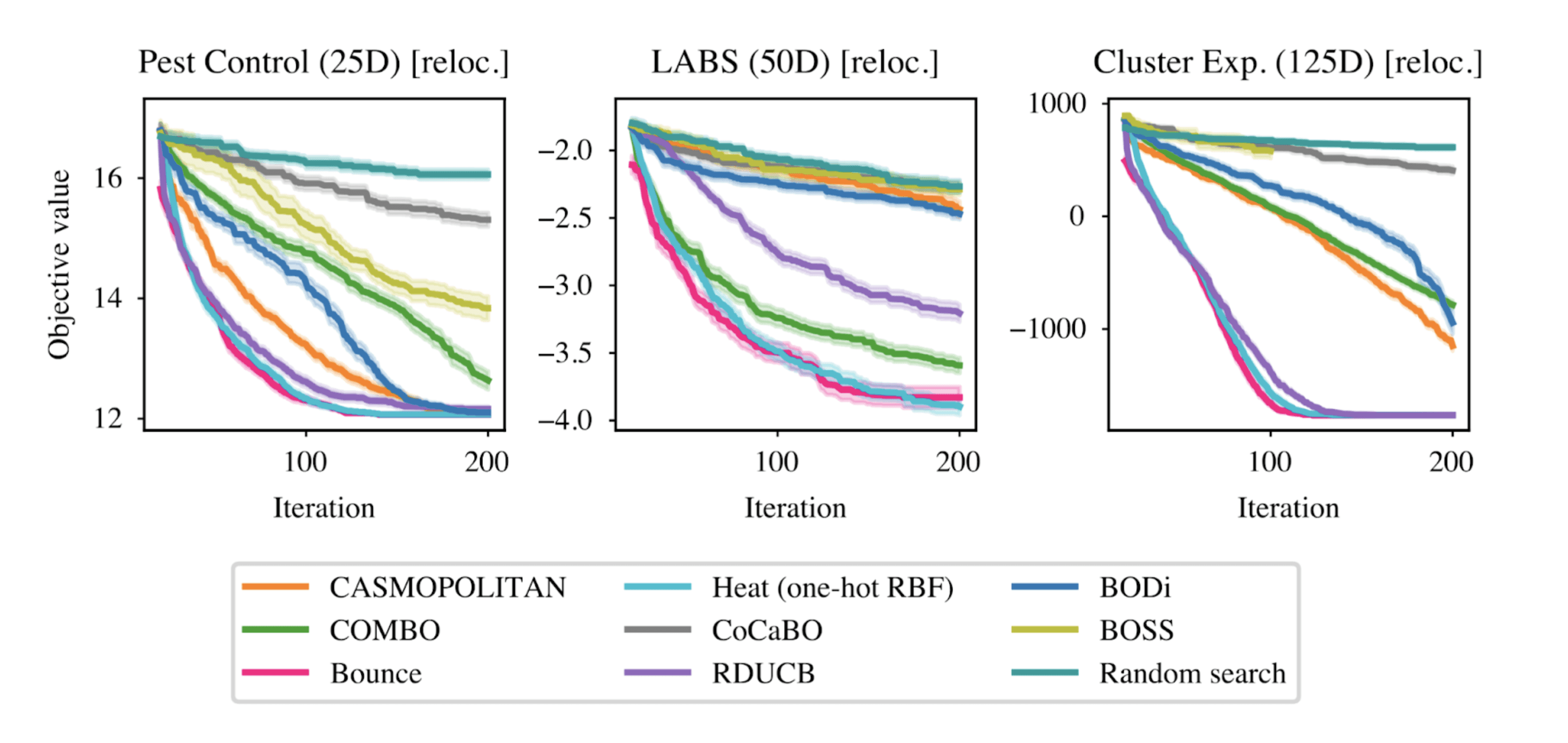
A fast and simple pipeline, relying on heat kernels, achieves state-of-the-art results, matching or even outperforming more complex or slow baselines.
At Secondmind, we pride ourselves on bridging the gap between state-of-the-art academic research and the future of enterprise-grade Engineering AI. By distilling these complex theories into a unified framework, we ensure that our partners can navigate the combinatorial explosion of modern automotive design with confidence, turning "small data" into big breakthroughs.
This latest research is a testament to how we push the state-of-the-art with the physical world in mind. In automotive design, a "categorical choice" isn't just a label; it’s a physical component with real-world constraints. By mastering this combinatorial complexity, we ensure our research remains grounded in the high-stakes reality of the proving ground.
Read the paper ‘Omnipresent Yet Overlooked: Heat Kernels in Combinatorial Bayesian Optimization’ here.